


A Beginner's Guide to Lighting Dried Flower Arrangements at Home
Most dried flower arrangements fail in the evening. In daylight they look tender and papery; after dark, under a ceiling light, they flatten into a brownish shape on the sideboard. The flowers haven't changed. The light has. Dried stems are matte, low in contrast and often close in tone to the wall behind them, so the quality, direction and colour of the light near them does almost all the work of making them legible. Get it right and a handful of grasses looks deliberate. Get it wrong and an expensive arrangement looks like something left out to dry.
What dried material actually does with light
Fresh flowers hold moisture in their petals, which gives them a faint translucency; light enters and comes back softened. Dried flowers don't do this. The tissue is papery and opaque, so light mostly bounces off the surface, and that surface is rough. Texture therefore matters more than brightness.
A smooth, diffuse wash from above shows you the silhouette and very little else. A light arriving from the side catches the ridges on a seed head, the fine hairs on a grass panicle, the curled edge of a dried rose petal. Two things follow. First, you are lighting an object, not a room. Second, the light needs to come in at an angle rather than straight on.
Colour matters too. Dried material tends toward amber, ochre, sage, dusty pink, rust and bone — low-saturation tones that shift easily under a strong colour cast.
Warm versus neutral light
Colour temperature is measured in kelvin, and the numbers on the bulb packaging are your guide.
- Warm white, roughly 2700–3000K. An amber-yellow cast. It flatters rust, terracotta, ochre, dried wheat and deep browns, and makes a corner feel inhabited at night. The risk is that it pushes sage greens and blue-greys toward mud, and it can merge two similar tones — a bleached grass and a pale seed head may read as one shape.
- Neutral white, roughly 3500–4000K. Whiter, quieter, closer to the truth. This is the safer choice for mixed arrangements, anything with blues, greens or greys, and any piece where you want the colours you chose. The risk is clinical flatness if it is the only light in a living room.
- Cool or daylight, 5000K and up. Rarely kind to dried material at home. Papery browns go grey and the arrangement starts to look dusty even when it isn't.
Kelvin isn't the whole story. If a bulb's packaging lists a colour rendering index, higher is better; a CRI in the nineties renders colour faithfully, while many inexpensive LEDs sit lower. You don't need to memorise figures. Hold the arrangement under the lamp and look: if the greens have gone grey or the pinks have gone orange, the source is doing something you didn't ask for.
Mixing two colour temperatures in one room
Keep the room's general lighting warm and flattering, then add one small neutral or high-rendering source aimed only at the arrangement — a picture light, a clamp lamp, a rechargeable table lamp used for this one job. The eye adapts within seconds. What you notice is that the flowers look right, not that two colour temperatures share a room.
Put the light to one side
Direction changes more than colour does. Place a small lamp to the side of the vase, slightly above the height of the flowers, so the beam arrives at roughly forty-five degrees. For a table lamp, something like thirty to fifty centimetres from the stems is usually enough to shape the arrangement without blowing out the highlights.
Two setups to avoid. A downlight directly overhead erases texture and drops a hard shadow under every stem. A light directly in front flattens the whole thing into a diagram of itself. If the ceiling fixture is your only option, move the vase so it sits at the edge of the pool of light rather than dead centre, and let the falloff do the shaping.
Placement that slows fading
Light fades dried flowers; that is unavoidable, only slowable. Pigments in dried plant material break down under ultraviolet and, more gradually, under visible light. Deep reds and oranges are usually the first to wash out, drifting toward beige while the browns seem to hold.
- Keep the arrangement out of direct sun. A south-facing sill in summer will bleach a bunch within a season.
- Bright indirect light is fine and often ideal — a north-facing room or a spot a metre back from a window.
- Give lamps breathing room. LEDs run cooler than halogen, but any bulb close enough to warm the stems is too close.
- Rotate the vase a quarter turn every few weeks so one side doesn't take all the light.
- Keep away from radiators, kitchen steam and bathroom humidity, which soften stems as surely as sun bleaches them.
- If a piece sits near a window, close the curtain through the brightest hours of a July afternoon.
A simple evening setup, step by step
- Switch the room lights off an hour before sunset and look at the arrangement in the last of the daylight. That is the version you are trying to reproduce.
- Add one small lamp to the side, roughly level with the middle of the stems.
- Raise or lower it until the light grazes the top third of the arrangement and you can see individual seed heads rather than a mass.
- Step back three metres. If the flowers disappear, the lamp is too dim or too far; if the wall behind is blazing, it is too close.
- Add a very soft background light — a floor lamp across the room at low output — if the corner feels like a stage set.
- Put the lamp on a dimmer or a timer so the arrangement is lit for the hours you actually sit in the room.
Backdrops, shadows and the small things
The wall behind does half the work. A pale arrangement against a pale wall reads by silhouette; the same arrangement against a deep, matte colour glows. What rarely works is a mid-tone, patterned backdrop, which competes with fine stems and wins. If you can't repaint, a large sheet of board or a length of linen propped behind the vase is enough.
Shadows deserve a mention because they are free material. One directional source gives one clean shadow, which can fall across a wall and double the height of the composition. Three sources give three overlapping shadows and a muddy result. When in doubt, fewer lamps.
And dust. Dried flowers collect it, and dust scatters light, which is why a tired arrangement looks dull rather than merely old. Every month or so, use a hairdryer on the cool setting, held at arm's length, or a soft brush, working with the direction of the stems. Handle the piece as little as possible otherwise; brittle stems snap where they are handled most.
Before you switch it on
Keep every lamp a safe distance from papery material, and never let stems, fabric or a dried wreath touch a bulb or sit against a shade. Check that cables aren't running through a damp sill or under a heavy vase. LED sources are the sensible default in a room full of dry plant material, and a dimmer lets you drop the level in the evening without losing the shape.
Then do the only test that counts. Sit where you actually sit, at the hour you actually sit there, and look. If the arrangement holds its texture, keeps its colour and throws one good shadow, the lighting is finished. If it doesn't, move the lamp a hand's width and look again.
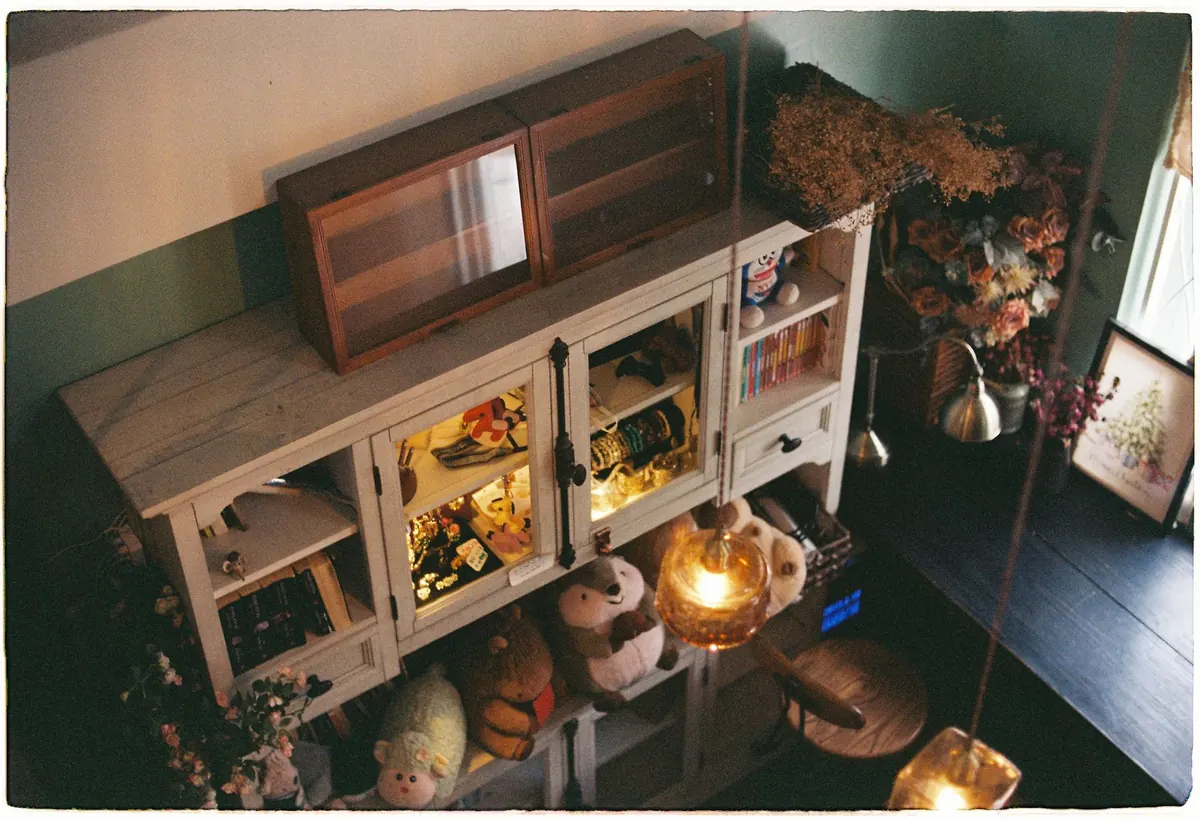
Photo: Thanh Bui / Pexels